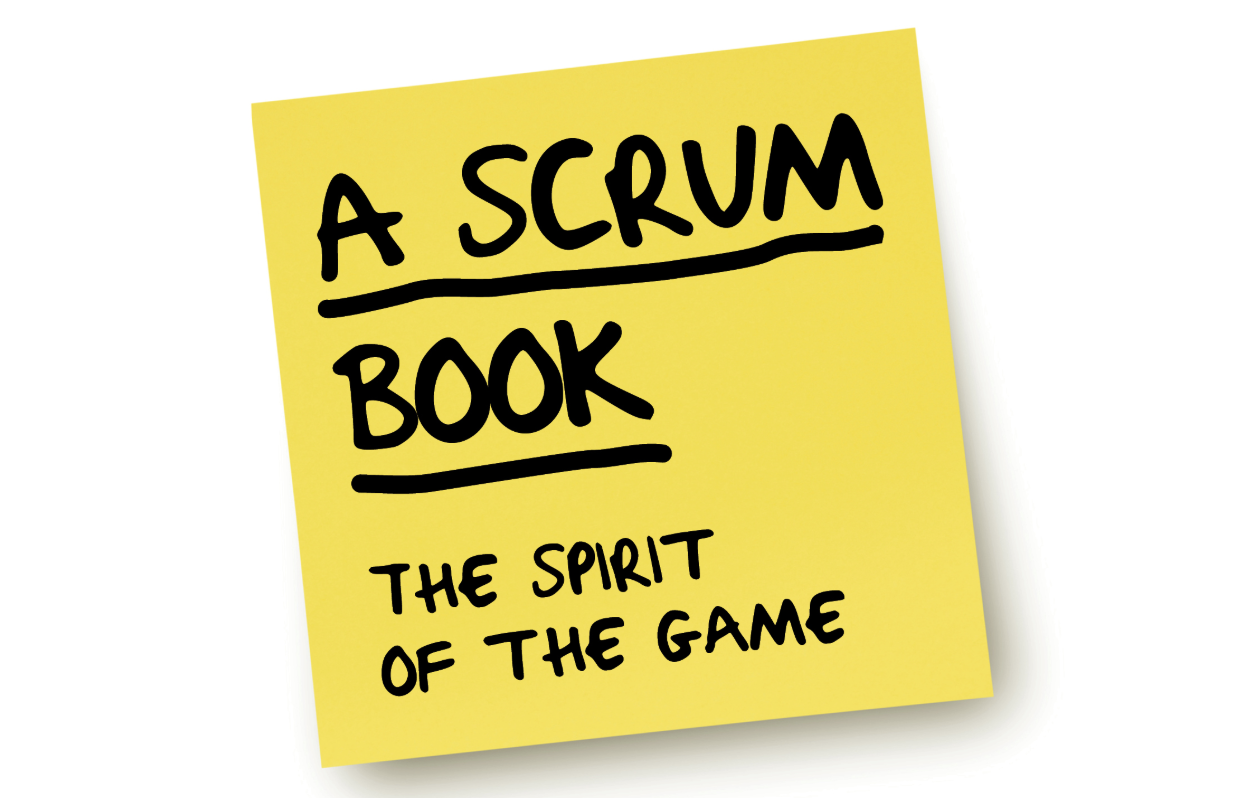
German edition: Scrum – Ein Buch über Zusammenarbeit
Do we really need another Scrum book? That was my first reaction. What changed my mind was the name on the cover. Jeff Sutherland, co-creator of Scrum, wrote it together with James O. Coplien, an early influence on Scrum and co-founder of the Hillside Group, the software pattern movement. I only meant to skim it. Two hours later I was still reading, and the book moved to the front row of my shelf.
Patterns instead of prescriptions
The book’s subtitle in English, The Spirit of the Game, picks up the Scrum Guide’s own subtitle, “The Rules of the Game.” The rules are easy to describe. The harder question is how people actually play. The book answers it with patterns. The authors tie the main elements of Scrum to patterns, to hone your intuition of how they work together. The German edition, published by Vahlen in 2022, runs to 488 pages and is organized in three parts: the Scrum core, a pattern language for the product organization (the organization that builds a product), and one for the value stream (the flow the product moves along). Together they describe 94 patterns.
You don’t have to read it front to back
The authors recommend getting an overview of the patterns first (they appear in bold), marking the ones worth remembering, and then reading those chapters in depth. The one exception is the first pattern, The Spirit of the Game. It explains what patterns are and builds your intuition for them. As the authors put it, Scrum can be thought of as a game that never ends, and you don’t have to use all the patterns. Along the way you also find a line we use in our own Scrum training: there is no Scrum police. Nobody will come to arrest you for breaking a rule. Scrum is about changing habits and discovering better ways of working together, and a team that treats it as a set of procedures will get little out of it. That is why understanding the patterns behind Scrum matters.
What impressed me
- Practical illustrations. Diagrams and sketches make each pattern concrete and show how to apply it in a real team.
- Beyond the basics. Later patterns cover scaling, combining Scrum with other agile approaches, and adapting it to different contexts, which makes the book worthwhile for experienced practitioners.
- Easy to navigate. All 94 patterns are listed again at the end of the book, so it is easy to find the one you want to revisit.
One caveat
The depth that rewards experienced readers can overwhelm beginners. Some concepts assume prior experience with Scrum. The authors have still tried to keep the text accessible, with enough explanation and examples to help newcomers find a way in. Anyone just starting out might use it as a companion to a team’s first sprints rather than reading it cover to cover.
Verdict
This is not a book you read once and shelve. It is a reference for Scrum Masters, agile coaches, and teams who want to understand why Scrum works and not only how to run its events. I now keep it within arm’s reach.